Socket Button Head Screw
©Nxlon.com D/T:
The socket button head screw is a relatively common fastener. The following is a detailed introduction to the socket button head screw:
Structural Characteristics of the Socket Button Head Screw
Head Shape: The head is a button head, which is hemispherical or approximately hemispherical. This shape makes the surface of the head round and smooth after the screw is installed. It is not only aesthetically pleasing but also suitable for some occasions where scratching or collision needs to be avoided. For example, on the surface of the casing of some instruments and equipment, it will not cause personal injury or damage to other components due to a sharp screw head.
Hexagonal Socket: Similar to the socket countersunk head screw, there is a hexagonal socket in the center of the head. The design of the hexagonal socket makes it convenient to use a hexagon socket wrench for tightening or loosening operations. It can apply torque more evenly, effectively prevent the wrench from slipping, and achieve relatively precise torque control, thus ensuring the tightness of the connection.
Threaded Shank: It has a standard threaded shank, and there are various thread specifications, such as metric threads like M2, M2.5, M3, M4, M5, etc., as well as other specifications like imperial threads. Different thread specifications are suitable for different connection objects and load-bearing requirements. A reliable fastening connection is achieved through cooperation with the corresponding threaded holes.
Specification Dimensions of the Socket Button Head Screw
Diameter: The common diameter range is generally from about M2 to M20. Socket button head screws with smaller diameters are often used for the assembly of small electronic products, precision instruments, etc., such as the connection of internal components of watches, cameras, etc.; those with larger diameters can be used in some mechanical structures or equipment with higher requirements for connection strength, such as the connection of components of large motors, speed reducers, etc.
Length: The length specifications are relatively diverse, usually ranging from a few millimeters to dozens of millimeters, such as 4mm, 6mm, 8mm, 10mm, 12mm, 16mm, 20mm, 30mm, etc. The selection of its length mainly depends on the thickness of the connected part and the actual installation space. It is necessary to ensure that after the screw passes through the connected part, there is still enough thread length for tightening the nut or for effective cooperation with the threaded hole to ensure the firmness of the connection.
Materials and Surface Treatments of the Socket Button Head Screw
Materials: It is usually made of high-quality carbon steel, such as 35 steel, 45 steel, etc. Through appropriate heat treatment processes, the strength and toughness of the screw can be improved to meet the usage requirements of the general industrial field. For some screws working in special environments, special materials will be selected. For example, in corrosive environments, stainless steel materials, such as 304 stainless steel and 316 stainless steel, are often used to enhance corrosion resistance; in high-temperature environments, heat-resistant steel may be used to ensure that the screw can still maintain good mechanical properties at high temperatures.
Surface Treatments: In order to improve the corrosion resistance, wear resistance, and aesthetic appearance of the screw, surface treatments are generally carried out on it. Common surface treatment methods include galvanizing, nickel plating, chrome plating, blackening, etc. Galvanizing treatment has a low cost, can form a zinc layer on the surface of the screw, effectively prevent rust, and is widely used in various industrial occasions; nickel plating and chrome plating treatments can make the surface of the screw brighter and more beautiful, and at the same time improve its corrosion resistance and wear resistance, and are often used in products with high requirements for appearance quality; blackening treatment is to form a black oxide film on the surface of the screw through chemical methods, which has a certain rust prevention ability and a relatively simple appearance, and is often used in some occasions where there are not high requirements for appearance but a certain protective performance is needed.
Application Fields of the Socket Button Head Screw
Electronics and Electrical Appliances: It is widely used in the manufacturing of electronic equipment, such as the assembly of the internal structures of electronic products like computer motherboards, mobile phones, and tablets. Its button head design can avoid scratching other electronic components or circuits inside the equipment. At the same time, the hexagonal socket is convenient for precise installation and disassembly, meeting the requirements of high-precision assembly of electronic products.
Mechanical Manufacturing: It is used for the connection of components of various mechanical equipment, such as the protective covers of machine tools, the end covers of motors, the casings of speed reducers, etc. After the socket button head screw is installed, the surface is flat, which will not affect the overall appearance and operational stability of the equipment. Moreover, the hexagonal socket can provide sufficient torque transmission to ensure the reliability of the connection and withstand various forces and vibrations during the operation of the mechanical equipment.
Instruments and Meters: It is often used in the manufacturing and maintenance of various instruments and meters, such as analytical instruments, measuring instruments, automated instruments, etc. Since instruments and meters usually have high requirements for appearance and precision, the socket button head screw can not only ensure the aesthetic appearance of the instrument surface but also achieve precise fastening connection, helping to improve the overall performance and stability of the instrument.
Installation and Usage Precautions of the Socket Button Head Screw
Inspection Before Installation: Before installation, it is necessary to carefully check whether the specification of the screw matches the threaded hole of the connected part, including parameters such as diameter and pitch. At the same time, it is necessary to check whether there is any damage or deformation in the hexagonal socket of the screw head, whether the threaded shank is bent, and whether the threads are complete. If there are any defects, it should be replaced in a timely manner to avoid affecting the installation and usage effects.
Proper Installation: Select a hexagon socket wrench of the appropriate size and insert it accurately into the hexagonal socket to ensure a tight fit between the wrench and the socket wall. When tightening the screw, keep the wrench vertical and stable and operate according to the specified torque requirements. Avoid excessive torque, which may cause the screw to break or the threads to be damaged, and also avoid too small torque, which may result in an insecure connection. For some high-precision or equipment with special requirements, a torque wrench may be needed to precisely control the tightening torque. In addition, during the installation process, ensure that the screw is perpendicular to the surface of the connected part to ensure uniform force and improve the connection strength.
Maintenance and Replacement: During the use process, regularly check the connection condition of the socket button head screw to see if there are any phenomena such as looseness, corrosion, or wear. If the screw is found to be loose, use a hexagon socket wrench to tighten it in a timely manner; if the screw is found to be severely corroded or worn, in order to ensure the safety and reliability of the connection, replace it with a new screw in a timely manner. Especially in some harsh working environments, such as humid, high-temperature, and high-vibration environments, strengthen the inspection and maintenance of the screw to extend its service life and ensure the normal operation of the equipment.
尼小龙塑料螺丝-塑料螺母-尼龙垫圈-塑料铆钉

R2024-塑料铆钉-尼龙铆钉
订购链接:Nxlon.com/2024
R2024-塑料铆钉-尼龙铆钉塑料铆钉-尼龙铆钉-汽车塑胶铆钉-尼小龙尼龙铆钉R2.6R3.5R4R5塑胶柳钉子母铆钉快捷紧固件塑料卡扣。
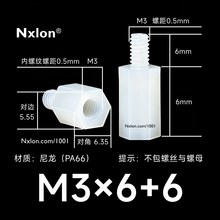
HTS-306尼龙单通六角隔离柱
订购链接:Nxlon.com/8007
HTS-306尼龙单通六角隔离柱通常由六角柱头部和外牙螺纹部分组成。六角柱头部方便使用工具进行拧紧或松开操作,外牙螺纹则用于与其他带有内螺纹的部件进行连接固定。


绝缘尼龙垫圈塑料垫片
订购链接:Nxlon.com/1010
绝缘尼龙垫圈塑料垫片是以尼龙为材质的平垫圈,在电子、机械等领域应用广泛,尼龙垫圈材质:尼龙66,颜色:黑色;规格:公称内径*公称外径*公称厚度


R4040-塑料铆钉-尼龙铆钉
订购链接:Nxlon.com/4040
R4040-塑料铆钉-尼龙铆钉塑料铆钉-尼龙铆钉-汽车塑胶铆钉-尼小龙尼龙铆钉R2.6R3.5R4R5塑胶柳钉子母铆钉快捷紧固件塑料卡扣。


R3535-塑料铆钉-尼龙铆钉
订购链接:Nxlon.com/3535
R3535-塑料铆钉-尼龙铆钉塑料铆钉-尼龙铆钉-汽车塑胶铆钉-尼小龙尼龙铆钉R2.6R3.5R4R5塑胶柳钉子母铆钉快捷紧固件塑料卡扣。