High-strength Washers for Steel Structures
©Nxlon.com D/T:

High-strength washers for steel structures are important accessories used for the connection of steel structures. The following is a detailed introduction to high-strength washers for steel structures:
Relevant Standards of High-strength Washers for Steel Structures
GB/T 1230-2006: The national standard "High-strength Washers for Steel Structures" stipulates the dimensions, technical conditions, test methods, and other contents of high-strength washers for steel structures. This standard is applicable to washers used for large hexagon head high-strength bolt connection pairs and torque-shear type high-strength bolt connection pairs.
Structural Features of High-strength Washers for Steel Structures
Shape: Generally circular, with a standard bolt hole in the middle for passing high-strength bolts.
Dimensions: Its dimensions such as inner diameter, outer diameter, and thickness are determined according to the specifications of the high-strength bolts it matches, and the dimensional accuracy requirements are relatively high. For example, for an M16 high-strength bolt, the inner diameter of the washer is generally about 17mm, the outer diameter is about 30mm, and the thickness is approximately 3mm.
Materials: Usually, high-quality carbon structural steels such as No. 45 steel and No. 35 steel, or alloy structural steels such as 40Cr and 35CrMo are used. After appropriate heat treatment, these materials can obtain higher strength and hardness to meet the requirements of steel structure connections.
Working Principle of High-strength Washers for Steel Structures
Dispersing Pressure: In the connection of steel structures, a large pre-tightening force will be generated when the high-strength bolts are tightened. The washer evenly distributes the pre-tightening force of the bolt on the surface of the connected component by increasing the contact area between the bolt head and the surface of the connected component, avoiding the deformation or damage of the surface of the connected component caused by excessive local pressure.
Compensating for Deformation: During the use of steel structures, they will be affected by various external forces and may produce a certain amount of deformation. The washer has a certain degree of elasticity and can, to a certain extent, compensate for the deformation of the connected component, keeping the pre-tightening force of the bolt stable and ensuring the reliability of the connection.
Preventing Loosening: The presence of the washer can increase the frictional force between the bolt and the connected component, helping to prevent the bolt from loosening under the action of vibrations or other external forces and improving the stability of the connection.
Advantages of High-strength Washers for Steel Structures
High Strength: It can bear large pressures and tensile forces, ensuring the strength and reliability of steel structure connections.
Good Toughness: When subjected to external forces, the washer not only has high strength but also a certain degree of toughness, and can adapt to the deformation of the steel structure without brittle fracture.
High Precision: With high dimensional accuracy, it closely matches the high-strength bolts and can effectively play its role.
Application Fields of High-strength Washers for Steel Structures
Building Steel Structures: At the connection joints of structures such as industrial plants, high-rise buildings, and bridges, it is used to connect components such as steel beams, steel columns, and steel trusses to ensure the integrity and stability of the structure.
Tower Structures: Including transmission towers, communication towers, etc. High-strength washers can ensure the firm connection between various components of the tower and can withstand the action of external forces such as wind loads and seismic loads.
Precautions for Selecting High-strength Washers for Steel Structures
Size Matching: The size of the washer must be accurately selected according to the specifications of the high-strength bolt to ensure that the fit clearance between the inner diameter of the washer and the bolt diameter is appropriate, and the outer diameter can provide sufficient support area.
Materials and Performance: Select washers of appropriate materials and performance grades according to the usage environment and force-bearing requirements of the steel structure. For example, in steel structures in corrosive environments, washers with anti-corrosion treatment or made of stainless steel materials can be selected.
Quality Inspection: Pay attention to the quality of the washers during procurement, check for surface defects, dimensional deviations, and other issues, and require the supplier to provide quality certification documents of the products. Sampling inspection can be carried out if necessary to ensure that the performance of the washers meets the relevant standards and engineering requirements.
尼小龙塑料螺丝-塑料螺母-尼龙垫圈-塑料铆钉

绝缘透明塑料六角螺母
订购链接:Nxlon.com/1016
绝缘透明塑料六角螺母是一种采用聚碳酸酯(PC)材料制成的具有特定功能和特性的塑料螺母,尼小龙现有塑料螺母M3、M4、M5、M6、M8等公制规格。

绝缘塑料法兰螺母
订购链接:Nxlon.com/1034
尼龙法兰螺母的螺纹规格有:M3*0.5、M4*0.7、M5*0.8、M6*1.0、M8*1.25、M10*1.5、M12*1.75等白色尼龙螺母、黑色塑料螺母、透明塑料法兰螺母。

R4040-塑料铆钉-尼龙铆钉
订购链接:Nxlon.com/4040
R4040-塑料铆钉-尼龙铆钉塑料铆钉-尼龙铆钉-汽车塑胶铆钉-尼小龙尼龙铆钉R2.6R3.5R4R5塑胶柳钉子母铆钉快捷紧固件塑料卡扣。


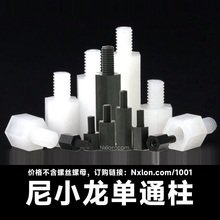
绝缘尼龙单通六角隔离柱
订购链接:Nxlon.com/1001
绝缘尼龙单通六角隔离柱:M2.5 M3 M4尼龙单头六角单通柱隔离柱采用先进的立体蜂巢结构全自动化脱模模具工艺高效成型!尼龙柱内螺纹是一次性注塑成型,不易滑牙!


绝缘尼龙垫圈塑料垫片
订购链接:Nxlon.com/1010
绝缘尼龙垫圈塑料垫片是以尼龙为材质的平垫圈,在电子、机械等领域应用广泛,尼龙垫圈材质:尼龙66,颜色:黑色;规格:公称内径*公称外径*公称厚度

